Estimated reading time: 8 minutes
If you’re considering permanent hair removal in Switzerland, you’ve probably encountered two competing technologies: laser and IPL (Intense Pulsed Light). Many clinics use these terms interchangeably — but they refer to fundamentally different technologies with different results, different safety profiles, and, since 2019, different legal requirements in Switzerland.
This guide explains exactly what separates laser from IPL, which works better for whom, and what Swiss law (V-NISSG) requires when choosing a provider.
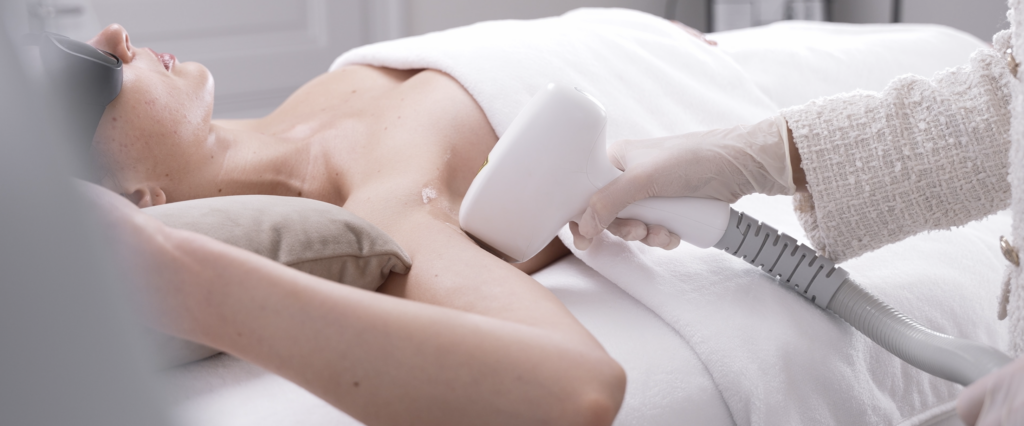
The simplest answer: laser uses a single, focused wavelength of light. IPL uses a broad spectrum of light.
That distinction sounds technical, but it explains everything that follows — effectiveness, safety, suitability for different skin types, and cost over time.
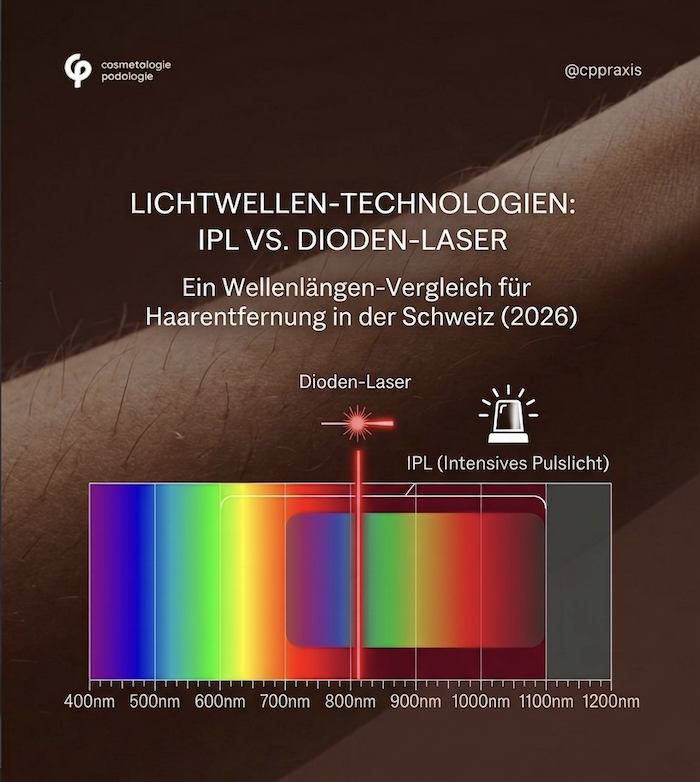
A medical-grade diode laser, like the 810 nm system used at CP Praxis, emits a single, precise wavelength of light that is absorbed by the melanin pigment in the hair follicle. The energy converts to heat, permanently disabling the follicle’s ability to produce new hair.
Because the wavelength is calibrated specifically for hair follicles, it:
IPL devices emit a broad spectrum of light (typically 500–1200 nm) — not a single wavelength. Filters are used to narrow the range, but the technology remains less precise than a laser.
Because the energy is spread across many wavelengths:
Side-by-side comparison
| Factor | Diode Laser (810 nm) | IPL |
| Technology | Single wavelength | Broad-spectrum light |
| Penetration depth | 4–6 mm | 1–3 mm (surface) |
| Sessions needed | 8–10 | 12–20+ |
| Suitable skin types | Fitzpatrick I–IV | Fitzpatrick I–II only |
| Treatment of dark hair | Highly effective | Moderately effective |
| Permanent results | Up to 90% reduction | Up to 50–70% reduction |
| Pain level | Mild (with cooling) | Mild to moderate |
| Cost per session | Higher | Lower |
| Total cost (full plan) | Comparable or lower | Often higher due to more sessions |
| Swiss V-NISSG required | Yes | Yes |
A common misconception is that IPL is cheaper. Per session, this is usually true. But over the full treatment cycle, the math changes:
Diode laser
IPL
For most clients, diode laser delivers permanent results at comparable or lower lifetime cost — and ends the cycle entirely, rather than requiring ongoing visits.
Since 2019, Swiss federal law has regulated who can perform medical laser and IPL hair removal treatments. The law, known as V-NISSG (Verordnung über nichtionisierende Strahlung und Schall) and V-NISRA, requires specialists to hold an official Sachkunde certification.
The transition period for the law ended in 2024. Since then, only certified specialists can legally perform these treatments in Switzerland.
This applies to both laser and IPL — but enforcement varies, and many beauty salons in Switzerland continue to operate without the required certification.
Before booking any laser or IPL session in Switzerland, you have the right to ask:
Any qualified provider will answer these questions transparently. At CP Praxis, every laser session is performed exclusively by Sachkunde V-NISSG certified specialists — a standard not every clinic in Switzerland meets.
Diode laser (810 nm) works best for:
IPL can be a reasonable choice for:
IPL is not recommended for darker skin tones, lighter hair colors, or clients seeking truly permanent results.
Both technologies share several contraindications:
A free consultation with a V-NISSG certified specialist will confirm whether either method is right for your specific case.
Whether you’re considering laser or IPL, ask the clinic these five questions before you commit:
If a clinic cannot answer all five questions clearly, look elsewhere.
For most clients in Switzerland seeking permanent hair removal, medical-grade diode laser is the more effective, longer-lasting, and ultimately more economical choice than IPL. The technology is more precise, the results are more permanent, and the total investment over time is typically lower.
That said, both treatments require a V-NISSG certified specialist by Swiss law. Verify this before booking — regardless of which method you choose.
If you’re considering laser hair removal in Basel or Bottmingen, we offer a free 15-minute consultation with a Sachkunde V-NISSG certified specialist. We’ll assess your skin and hair type, confirm whether laser is right for your case, and provide a clear cost estimate before you commit.
Frequently Asked Questions
Per session, IPL is usually cheaper than laser. However, IPL requires more sessions (typically 12–20 vs 8–10 for laser), so the total cost over the full treatment cycle is often comparable or higher than diode laser. Laser also tends to deliver more permanent results.
No. IPL typically achieves 50–70% hair reduction, while medical-grade diode laser can achieve up to 90% permanent reduction. IPL also requires ongoing maintenance, while laser delivers lasting results after a complete cycle.
Both are safe when performed by certified specialists. However, laser is more precise and works on a wider range of skin tones, including darker skin (Fitzpatrick III–IV). IPL is limited to lighter skin tones (Fitzpatrick I–II) due to the risk of burns on darker skin.
Yes, but only when performed by a Sachkunde V-NISSG certified specialist. This requirement has been mandatory since the transition period ended in 2024. The same requirement applies to IPL treatments.
Ask the clinic to confirm the device name and exact wavelength. A medical-grade diode laser operates at 810 nm. IPL devices operate across a broad spectrum (typically 500–1200 nm). Many clinics market IPL as “laser” — the wavelength is the most reliable way to verify.
This article is for informational purposes and does not constitute medical advice. For an individual assessment, book a free consultation with a Sachkunde V-NISSG certified specialist at CP Praxis Basel or Bottmingen.
Last updated: May 2026