
Quick answer: VISIA, Observ 520x, and LumiScan Pro are three of the leading multispectral skin analysis systems used in professional aesthetic and dermatological practice. VISIA (Canfield Scientific) is the most established system globally and uses standard, UV, and cross-polarised lighting across 8 measured parameters. Observ 520x (Sylton, Netherlands) adds parallel-polarised and Wood’s light to capture vascularity and surface texture in greater detail. LumiScan Pro is a newer-generation multispectral system focused on combining clinical imaging with structured 3-month treatment planning. The right choice for a client depends less on the brand and more on how the data is interpreted and translated into a personalised plan.
If you are deciding which clinic to book a skin analysis with, you have probably noticed that different practices use different systems – and the marketing for each tends to claim superior accuracy. The truth is more nuanced. All three systems described in this article are clinical-grade tools that capture objective data the human eye cannot see. The differences lie in which parameters they prioritise, how the data is presented, and most importantly, how a trained specialist translates the output into actionable treatment.
This guide breaks down the technical differences, the clinical applications, and what they mean for you as a patient.

Before comparing the systems, it helps to understand the underlying technology they all share. Multispectral imaging captures the same area of skin under different wavelengths of light. Each wavelength penetrates the skin to a different depth and reveals different information.
– Standard daylight shows surface tone, texture, and visible pigmentation.
– Cross-polarised light filters surface reflection and reveals subsurface structures: vascularity, pigment depth, inflammation.
– Parallel-polarised light emphasises surface detail: pores, fine lines, texture irregularities.
– Ultraviolet (UV) light reveals sun damage, photo-aging, and porphyrin markers from bacterial activity.
– Wood’s light (long-wave UV) is particularly effective for fungal, bacterial, and pigmentary anomalies.
The combined images are then processed by software that quantifies findings into numerical indicators (e.g., a “Pigmentation Index” or “Bacterial Activity Index”) and visual maps overlaid on the patient’s face. This is the data that drives a personalised treatment plan.
VISIA (manufactured by Canfield Scientific) is the most widely deployed professional skin analysis system globally and is often referred to as the clinical benchmark. Its current generation uses high-resolution photography combined with cross-polarised and UV lighting to capture eight parameters: spots, wrinkles, texture, pores, UV spots, brown spots, red areas, and porphyrins.
Strengths
– Largest validated clinical database, with extensive peer-reviewed research supporting its accuracy and reproducibility.
– Comparative norms — VISIA can compare your skin’s parameters against thousands of others in your same age, sex, and skin type bracket, giving you a relative percentile.
– Strong reputation in dermatology and high-end aesthetic practices.
– Excellent documentation and progress-tracking tools.
Limitations
– Less detailed mapping of vascularity and surface texture compared to systems with parallel-polarized lighting.
– The percentile-based reporting can be informative for some clients but is sometimes more useful for clinical research than for personal decision-making.
– The hardware footprint is large; not every clinic has space or budget for a VISIA Gen8.
Best suited for: Clients who want extensive comparative data and a clinically validated baseline, particularly for tracking long-term changes in pigmentation, texture, and photo-aging.
Observ 520x, made by Sylton in the Netherlands, is a newer-generation system that integrates five distinct light sources: daylight, cross-polarised, parallel-polarised, Wood’s light, and true UV. This broader lighting palette allows for more granular evaluation of surface texture, vascularity, and bacterial activity than systems using only three light sources.
Strengths
– Five-light imaging captures parameters that some other systems miss, particularly vascular detail and surface texture.
– Built-in patented Face Positioning System helps standardize image capture, improving reproducibility between sessions.
– Strong performance in detecting early bacterial colonization and inflammation patterns, which is highly valuable for acne and rosacea cases.
– Compact and portable enough for clinics that need flexibility in setup.
Limitations
– Smaller validated clinical dataset than VISIA, although peer-reviewed comparisons increasingly position Observ 520x as equivalent or superior in specific use cases.
– The depth and detail of the output requires a well-trained specialist to interpret correctly — the system is only as useful as the practitioner reading the data.
Best suited for: Clients with active acne, rosacea, sensitive skin, or vascular concerns where detailed inflammation and vascular mapping are the priority.
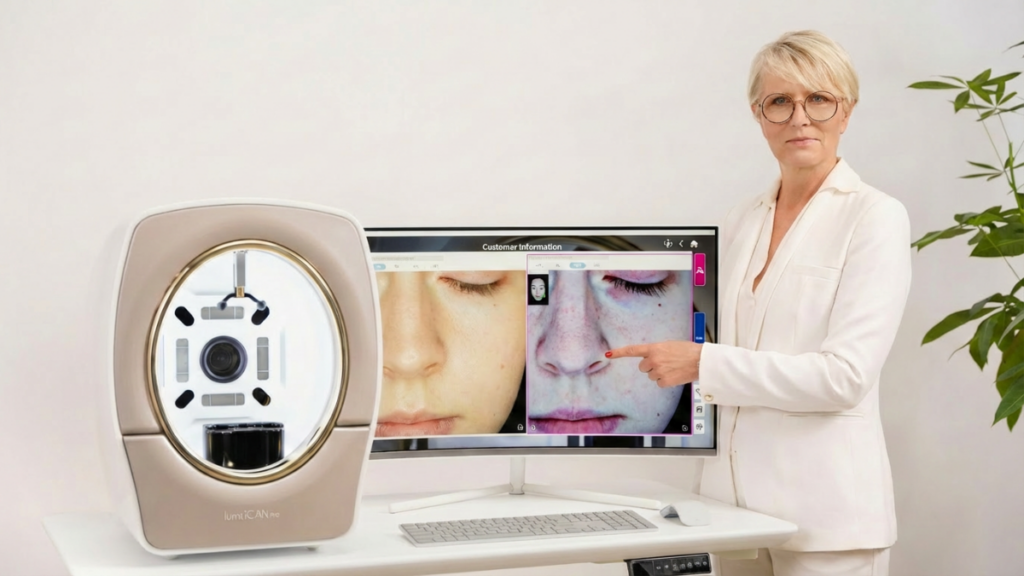
LumiScan Pro is the newer entrant in the multispectral skin analysis category, designed around the principle that imaging is only the first step — the value comes from how the data translates into a structured treatment protocol.
The system captures multispectral images across pigmentation depth, sebum activity, bacterial markers, vascularity and redness, early structural changes, and UV damage. The software is integrated with a clinical workflow that produces a structured 3-month treatment and home-care plan based on each individual analysis.
Strengths
– Integrated workflow that pairs multispectral data directly with a personalised 3-month treatment plan, including both clinical procedures and home-care recommendations.
– Strong emphasis on follow-up and progress measurement, with a structured second analysis at the end of each treatment cycle to objectively quantify change.
– The reporting style is patient-facing — clear visual maps and indicators are designed to be understandable in a consultation, not just a clinical report.
Limitations
– Newer to the market than VISIA, with a smaller body of independent peer-reviewed research published to date (this is a generally weaker point for any newer system, not a quality issue specific to LumiScan Pro).
– Best suited to clinics that follow a structured treatment-protocol model; less optimal for clinics that primarily document and refer out.
Best suited for: Clients who want objective baseline data immediately tied to a clear, time-bound treatment plan and measurable follow-up — rather than a one-off analysis they must interpret elsewhere.
| Parameter | VISIA Gen8 | Observ 520x | LumiScan Pro |
| Light sources | Standard, cross-polarized, UV | Daylight, cross-polarized, parallel-polarized, Wood’s, true UV | Multispectral (visible, polarised, UV) |
| Measured parameters | 8 (spots, wrinkles, texture, pores, UV spots, brown spots, red areas, porphyrins) | Surface texture, pigmentation, vascularity, wrinkles, volume, contouring | Pigmentation depth, sebum, bacteria, vascularity, structural changes, UV damage |
| Strength in pigmentation | Excellent | Excellent | Strong, with depth-layer differentiation |
| Strength in vascularity | Good | Excellent | Strong |
| Strength in bacterial detection | Good (porphyrin markers) | Excellent (Wood’s light) | Strong |
| Comparative norms | Yes (large database) | Limited | Practice-specific baselines |
| Treatment plan integration | Separate workflow | Separate workflow | Integrated 3-month plan |
| Best documented in research | Yes | Growing body | Growing body |
Here is the part most marketing materials skip. All three systems are clinical-grade. All three capture data that the human eye cannot see. The difference between a transformative skin analysis and a forgettable one is rarely about which machine is in the room.
The real difference is who reads the data.
A skilled specialist with a mid-range system will outperform a poorly trained operator with the most expensive equipment available. What separates a useful analysis from a useless one:
1. Diagnostic interpretation. Can the specialist look at your skin maps and identify the underlying cause, not just describe what is on screen? “Your Pigmentation Index is high” is a finding. “Your pigmentation is sitting at the dermal-epidermal junction, which means topical hydroquinone alone won’t reach it — we need a combined approach” is a diagnosis.
2. Translation to action. Does the analysis lead to a specific, time-bound plan with both clinical procedures and home care? Or does it stop at a printed report?
3. Objective follow-up. Is there a structured second analysis to measure whether the plan worked? If not, you have spent money on diagnostics without ever proving the treatment was correct.
4. Honest interpretation. Will the specialist tell you when a finding is clinically minor and not worth treating? Or are all findings turned into recommendations to sell?
These four factors matter more than the brand of the imaging hardware.
When you are deciding where to book your skin analysis, work through these questions in order:
1. What is your primary concern?
If your main issue is pigmentation or anti-aging tracking, any of the three systems will give you a strong baseline. VISIA’s comparative norms can be especially useful here. If your main concern is acne, rosacea, sensitive skin, or vascular issues, the parallel-polarized and Wood’s-light capabilities of Observ 520x are particularly well-suited. If your priority is having objective data immediately tied to a clear, structured treatment plan with measurable follow-up, LumiScan Pro is built around this workflow.
2. Is the clinic running a treatment-plan model or a documentation model?
A documentation model captures and prints findings; you take the report elsewhere or interpret it yourself. A treatment-plan model uses the analysis to drive a structured protocol with built-in follow-up. The latter is much more useful for most clients. Ask the clinic upfront which model they follow.
3. Who reads the data?
Ask whether your analysis will be reviewed by a trained skin therapist, dermatologist, or cosmetologist with relevant experience — and whether they will go through the results with you in person. A printed report handed over without explanation has limited clinical value.
4. Is follow-up included?
A second analysis at the end of your treatment cycle is essential to objectively verify whether the plan worked. Many serious clinics offer the follow-up scan complimentary as part of the treatment package.
All three systems described here are clinical-grade and validated for professional use. VISIA has the largest published research base and is often considered the clinical benchmark, particularly for pigmentation and photo-aging. Observ 520x performs particularly well on vascular and bacterial detail. LumiScan Pro pairs imaging with a structured treatment workflow. In practice, the accuracy of the analysis depends as much on the specialist interpreting the data as on the imaging system itself.
No. None of these systems are diagnostic devices for skin cancer or other pathological conditions. They are designed for cosmetic and dermatological assessment of conditions such as pigmentation, sebum, vascularity, and structural changes. If you have a suspicious mole, lesion, or any concern about skin cancer, see a dermatologist for a clinical examination.
Pricing varies more by clinic and region than by system. In Switzerland, a professional multispectral skin analysis typically costs between CHF 120 and CHF 200 for a 60-minute appointment, regardless of whether the underlying technology is VISIA, Observ, or LumiScan Pro.
No. A single multispectral analysis evaluates all major parameters at once: pigmentation, sebum, bacteria, vascularity, structural changes, and UV damage. The treatment plan that follows can address multiple concerns in parallel.
Most professional protocols recommend a follow-up analysis every 3 months during an active treatment cycle, then every 6-12 months for maintenance. The follow-up is what turns a one-off image into a measurable progress curve.
Yes, all three systems are CE-marked for use in professional cosmetic and dermatological practice in Europe. Verify the specific clinic’s equipment certification if you have any concerns, particularly if the system is being used for any procedure that goes beyond surface imaging.
The three systems are more similar than the marketing suggests. All capture multispectral data. All produce objective indicators that go beyond visual assessment. All are valid choices for a serious skin analysis.
Where they differ is in emphasis – VISIA is strongest on comparative norms and pigmentation/aging tracking, Observ excels on vascular and bacterial detail, and LumiScan Pro is built around an integrated treatment-and-follow-up workflow.
But the most important decision is not which brand of imaging system you book. It is which clinic and which specialist will translate that data into a treatment plan that actually changes your skin.
If you are based in or near Basel, you can book a multispectral skin analysis with the LumiScan Pro system at CP Praxis and receive a structured 3-month plan within 48 hours of your appointment.