
Estimated reading time: 11 minutes
Quick answer: Hydrafacial is a patented hydradermabrasion technology (Vortex-Fusion), FDA-cleared, with several peer-reviewed studies documenting its effects, including a significant improvement in acne in 65% of study participants after 6 treatments.
Important: this article is an informational overview of published research on the technology, not medical advice, and not a substitute for an individual assessment by a qualified professional. Individual results may vary. Many providers also advertise similarly named treatments such as Aquafacial or AquaPeel, which use different, non-patented devices. At CP Praxis in Basel, only the certified original device is used.
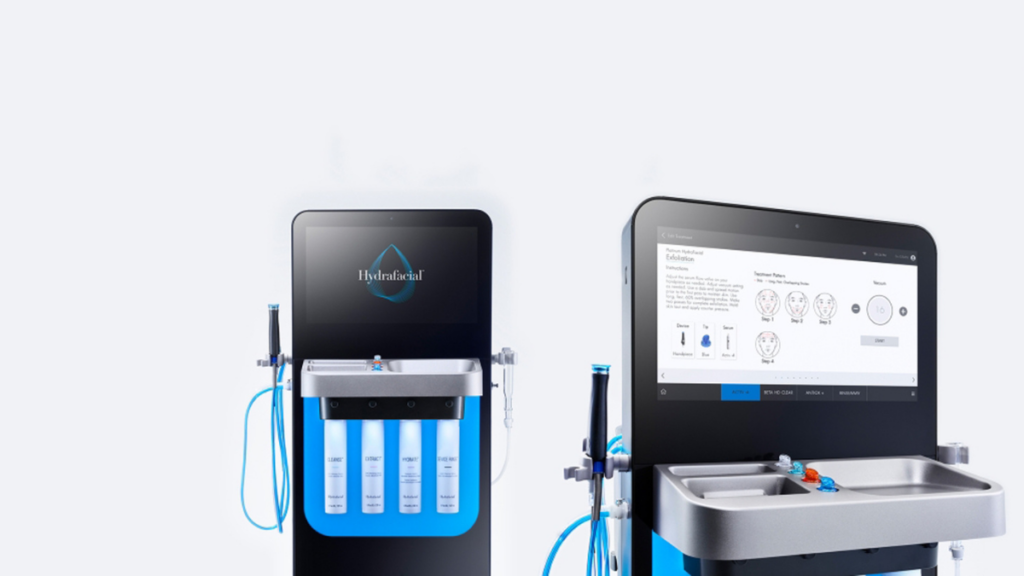
Hydrafacial is not a generic term for water-based facials. It is the brand name of a patented hydradermabrasion system made by The Hydrafacial Company (Long Beach, California). At its core is the patented Vortex-Fusion technology: a spiral-tipped applicator that simultaneously exfoliates, extracts pore debris through suction, and delivers ingredients such as hyaluronic acid, peptides and antioxidants in a single pass.
The device is FDA-cleared, and the Vortex-Fusion technology is patent-protected, meaning no other manufacturer can legally replicate the identical process. What other providers sell under names like Aquafacial or Hydro Peel is technically a different device, more on that below.
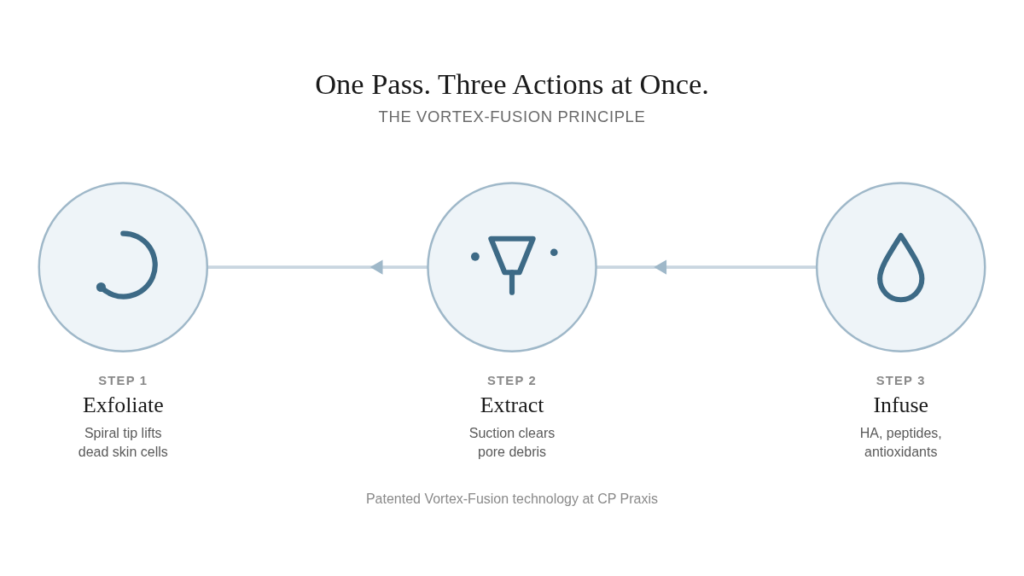
A detail often overlooked: Hydrafacial operates as a closed system. Everything removed from the skin during treatment stays inside the device and never comes back into contact with the skin. As Magdalena Brügger, founder of CP Praxis, explains: “Hydrafacial arbeitet mit einem geschlossenen System. Alles, was während der Behandlung entfernt wird, bleibt im Gerät und kommt nicht wieder mit der Haut in Kontakt” (Hydrafacial works with a closed system: everything removed during treatment stays inside the device and does not come back into contact with the skin). This is also why the patented tips matter: each one contains a specific spiral structure that, combined with the vacuum, allows thorough yet controlled cleansing before active ingredients are delivered.
Unlike many cosmetic procedures, Hydrafacial has several peer-reviewed studies behind it.
Study 1: Acne (Journal of Clinical and Aesthetic Dermatology, 2022). Storgard and colleagues studied 20 patients with mild to moderate acne across a multicentre trial, using six Hydrafacial Clarifying Treatments over 12 weeks. The proportion of patients with nearly clear skin rose from 20 to 65% by investigator assessment (p=0.0027) and from 5 to 55% by patient self-report (p=0.0016). After the final treatment, 100% of patients agreed their skin felt clearer and cleaner. For transparency: one co-author is an employee of The Hydrafacial Company, which is disclosed in the original publication.
Study 2: Skin structure and collagen (Journal of Cosmetic Dermatology, 2008). Freedman and colleagues compared six hydradermabrasion treatments against a control group in a randomised study of 20 participants. Treated skin showed a significant increase in epidermal and papillary dermal thickness, along with increased fibroblast density (p<0.01), suggesting genuine collagen remodelling rather than surface cleansing alone.
Study 3: LC-OCT imaging (Skin Research and Technology, 2024). Razi and colleagues used Line-Field Confocal Optical Coherence Tomography to non-invasively image skin before and after treatment. Immediately after treatment, the stratum corneum was measurably thinner (an exfoliation effect), but at the two-week follow-up it was thicker than baseline, suggesting genuine skin barrier renewal rather than a purely temporary peeling effect.
A registered clinical trial (ClinicalTrials.gov NCT05932732) is also currently assessing the treatment’s impact on skin quality, hydration and barrier function.
A note on interpretation: the studies cited above were conducted using the original Hydrafacial device, but not at CP Praxis itself; they took place at separate study sites in the United States. They show what this technology can achieve under controlled clinical conditions, not a guarantee of individual outcomes. How quickly and how much your own skin changes depends on your skin condition, treatment frequency and individual response.
The commercial success of Hydrafacial has led to a wave of similarly named alternatives: Aquafacial, AquaPeel, Hydro Peel, water-jet microdermabrasion and others. These devices work on a broadly similar principle: water, suction and active ingredients, but they are not technically the same procedure.
| Criterion | Hydrafacial (Original) | Aquafacial / generic hydrodermabrasion |
| Patent protection | Yes, Vortex-Fusion is patented | No, generic technology |
| Standardisation | Uniform, certified devices worldwide | Varies significantly by manufacturer |
| Clinical studies | Multiple peer-reviewed publications | Generally no independent studies |
| Active ingredient series | Fixed, tested formulas (Activ-4, GlySal, Beta-HD, Anti-Ox+) | Variable, manufacturer-dependent |
| Regulatory clearance | FDA-cleared | Inconsistent, often undocumented |
| Certified application | Only through certified providers | No uniform certification requirement |
This does not automatically mean every alternative device is ineffective, but it does mean the clinical evidence documented for Hydrafacial does not automatically transfer to other devices, even when providers promise similar results.
If a clinic cannot answer these questions clearly or avoids them, that is a reason for caution.
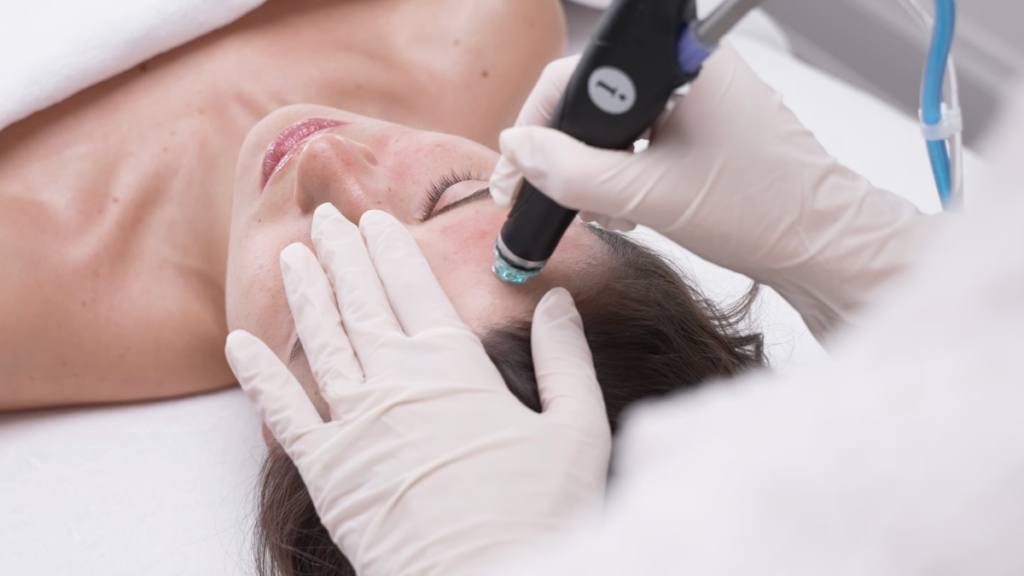
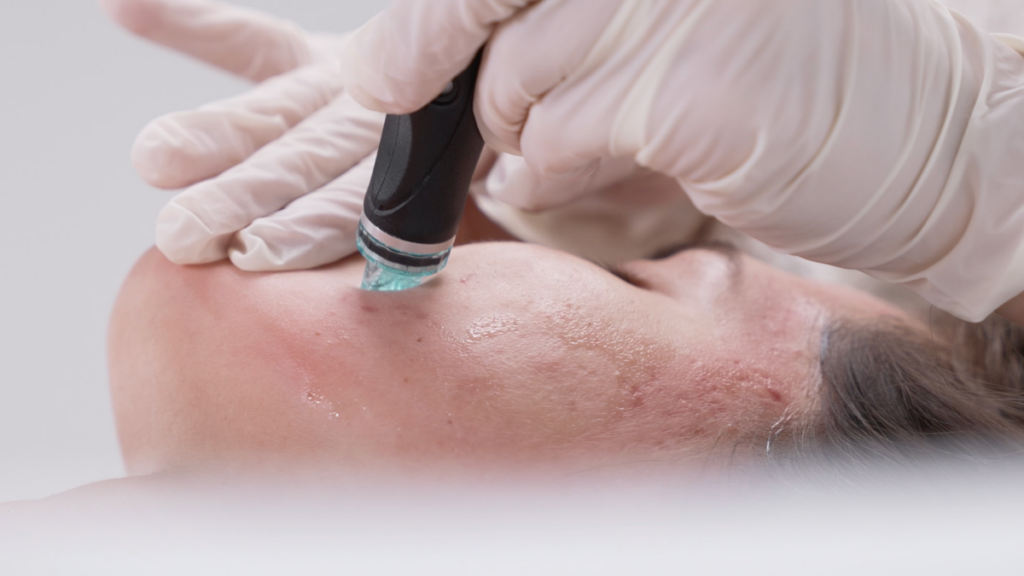
At CP Praxis in Basel, only the certified original Hydrafacial system is used. The treatment takes approximately 45 to 60 minutes and combines cleansing, exfoliation, extraction and hydration in one continuous session, with no downtime afterwards.
Watch Magdalena Brügger explain the technology:
Hydrafacial can be used as a standalone treatment for an immediate, visible glow, or as preparation before other treatments such as Microneedling or Mesotherapy. Even with daily cleansing at home, residues from sunscreen, makeup, and everyday products can remain on the skin. Hydrafacial’s controlled pressure and vacuum remove this buildup thoroughly, leaving the skin optimally prepared both for further clinical treatments and for the home care routine that follows.
Because Hydrafacial is non-invasive and gentle by design, it suits a wider range of skin types and concerns than more aggressive resurfacing treatments such as deep chemical peels or ablative lasers. That said, “suitable for almost everyone” does not mean “identical for everyone”: how much benefit you see, and how quickly, still depends on your specific skin condition, your goals, and whether any underlying issues need to be addressed first. The table below summarises who tends to benefit most from Hydrafacial as a starting point, and who should have a short conversation with a specialist before booking.
| Profile | Suitability |
| Dull, congested skin wanting an immediate glow | Well suited |
| Mild to moderate acne | Well suited, supported by clinical study above |
| Preparing for Microneedling or Mesotherapy | Well suited, commonly used as a prep step |
| No downtime needed before an event | Well suited |
| Active, inflamed cystic acne | Consult a specialist first |
| Very reactive or compromised skin barrier | Consult a specialist first |
| Pregnancy | Personalised assessment recommended |
None of this needs to be guesswork on your part. At CP Praxis, every new client can start with a professional skin analysis using LumiScan Pro before deciding on a treatment plan, so the recommendation is based on your actual skin data rather than a generic checklist. If Hydrafacial turns out not to be the ideal starting point for your skin right now, whether because of active inflammation, a compromised barrier, or another concern, your specialist will suggest a more suitable alternative, such as a gentler protocol from our Sensitive Skin line, and revisit Hydrafacial once your skin is ready for it.Based on the studies cited above and clinical experience, a visible glow effect is noticeable immediately after the first treatment. Structural improvements (collagen, skin barrier) require several sessions spaced two to four weeks apart, with measurable changes typically appearing after four to six sessions.
Is Hydrafacial the same as Aquafacial? No. Hydrafacial is a patented, FDA-cleared system with documented clinical evidence. Aquafacial and similarly named procedures use a comparable principle but different, non-patented devices without the same body of research.
Is there real scientific research on Hydrafacial? Yes. Peer-reviewed studies document a significant improvement in acne (Storgard et al., 2022) and structural skin improvements through increased fibroblast density (Freedman et al., 2008).
How do I know if a clinic uses the original device? Ask for the manufacturer’s name and the active ingredient series used. Original devices visibly display the brand name and serial number.
How often should I repeat Hydrafacial? For visible structural results, studies typically use four to six treatments spaced two to four weeks apart, followed by monthly maintenance sessions.
Magdalena Brügger
Founder and Owner of CP Praxis, Basel and Bottmingen
Magdalena Brügger built CP Praxis and continues to lead the clinical direction of both locations. Her focus is on ensuring the practice works exclusively with certified original devices and scientifically documented procedures, rather than unverified alternatives. This article was researched from publicly available, peer-reviewed studies and reviewed by her for accuracy.
Note: Ms Brügger is a cosmetologist and practice owner, not a dermatologist or physician. For medical skin concerns, we recommend also consulting a doctor.
This article is for informational purposes and does not replace individual medical advice.
Book your HydraFacial treatment at CP Praxis Basel.
Last updated: September 2026.