
Estimated reading time: 14 minutes
Quick answer: Microneedling is a collagen induction treatment with very fine needles that stimulates the skin to produce new collagen and elastin. Systematic reviews show that it is effective and safe for acne scars, and one study found up to 400% more collagen and elastin six months after four sessions. Classic microneedling works without heat, unlike RF microneedling, which can also affect the fat layer under the skin.
Important: this article is an informational overview of published research and Swiss regulations, not medical advice, and not a substitute for an individual assessment by a qualified professional. Individual results may vary. Many providers also offer RF microneedling or low cost pen treatments, which work differently. At CP Praxis in Basel and Bottmingen, we perform classic microneedling with the Swiss dermaneed device, within the cosmetic depth of up to 0.5 mm.
Microneedling is one of the best known skin treatments in the world, and one of the most misunderstood. Many people confuse it with mesotherapy or nanoneedling, and many studios now offer radiofrequency (RF) microneedling as if it were simply a stronger version of the same thing. It is not.
In this guide, Magdalena Brügger, founder of CP Praxis in Basel and Bottmingen, explains what really happens in your skin during microneedling, what independent research shows, how many sessions make sense, how to care for your skin afterwards, and why we deliberately work with classic microneedling instead of RF.
The video is in German. You can find the key points in English on our microneedling video page.
Microneedling, known in medical literature as collagen induction therapy or percutaneous collagen induction, uses a device with very fine needles. The needles move in and out of the skin at high speed and create thousands of tiny, controlled micro injuries.
These micro injuries are too small to leave marks, but large enough to send a clear signal to the skin: repair yourself. The skin responds with its natural healing process and produces new collagen and elastin, the two proteins that give skin its structure, firmness and elasticity.
The concept was developed further in the 1990s and 2000s by plastic surgeons such as Dr Desmond Fernandes and has since been studied extensively for scars, skin ageing and texture.
Magdalena Brügger likes to compare microneedling with lifting weights. A muscle does not grow because you lift a weight once. It grows because the weight gives it an impulse, and the body adapts by becoming stronger.
Microneedling works in the same way. The needle impulse tells the skin that it needs to improve its condition, and the repair process takes place exactly where collagen and elastin fibres are formed. This happens in three phases:
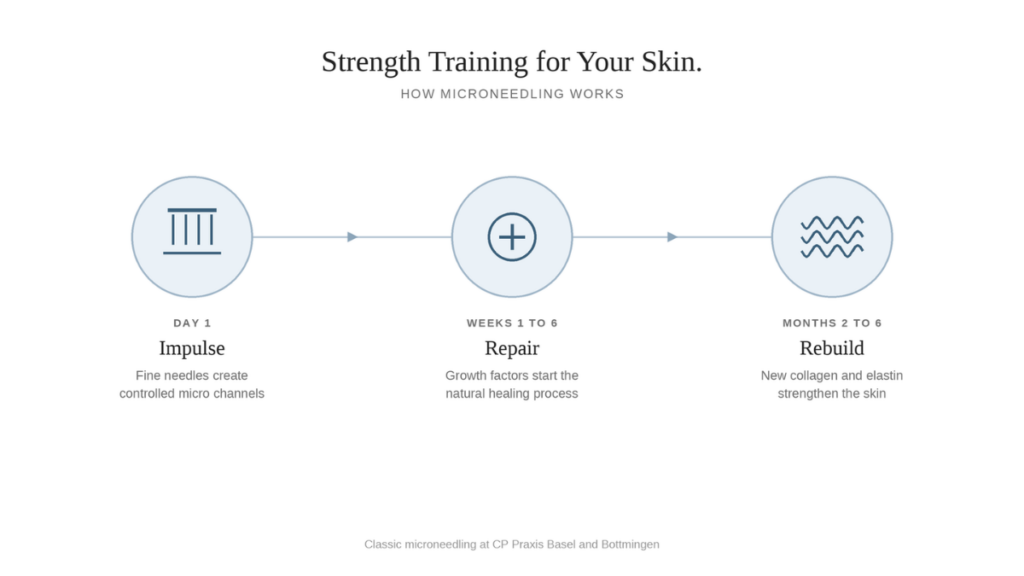
This is why results build up gradually. Skin often looks fresher after the first sessions, but the real structural improvement develops over weeks and months.
Microneedling is one of the better researched aesthetic treatments. Here is what the studies say, in plain words.
In a frequently cited 2008 study by Aust and colleagues, which analysed 480 patients, tissue samples taken six months after four microneedling sessions showed up to 400% more collagen and elastin than before treatment. Other studies have since confirmed a significant increase in collagen types I, III and VII after a course of treatment.
Acne scars are the best studied indication. A 2021 systematic review of randomised controlled trials in the International Wound Journal concluded that microneedling is an effective and safe treatment for atrophic scars, with few side effects and short downtime. In a scar, the connective tissue has changed. Microneedling helps the skin rebuild collagen and elastin there, so the texture can gradually become smoother.
Reviews of the literature show improvements in fine lines, skin texture and firmness after repeated sessions. Results are natural and gradual, which is exactly what most of our clients want.
As new collagen forms around the pore, it can contract more elastically and appear smaller. The evidence here comes from smaller studies and clinical experience and is less extensive than for acne scars, but in practice pore refinement is one of the effects our clients notice most.
Important: results vary from person to person. Studies describe averages, and your own skin, age and lifestyle influence how strongly your skin responds. Many of these studies used deeper, medical needling performed by doctors. Cosmetic microneedling works more superficially and gently, so results build up gradually over a course of sessions.
This is the difference most people do not know, and the reason we explain it in detail.
RF microneedling (radiofrequency microneedling) combines needles with heat. The needles release radiofrequency energy deeper into the tissue and heat it. This can tighten tissue, but it is a completely different treatment from classic microneedling.
The heat does not stay only in the skin. Research shows that RF microneedling can reduce subcutaneous fat. On the body this effect is sometimes used on purpose, for example in studies on skin laxity and fat deposits. On the face, however, the fat layer is thin and gives the face its volume and youthful shape. In some people, heating this layer can lead to a loss of volume, so the face may look thinner or more hollow afterwards.
That is a risk we do not want to take. For skin longevity, our goal is healthy, strong skin and a natural face for many years, not tighter skin at the cost of volume.
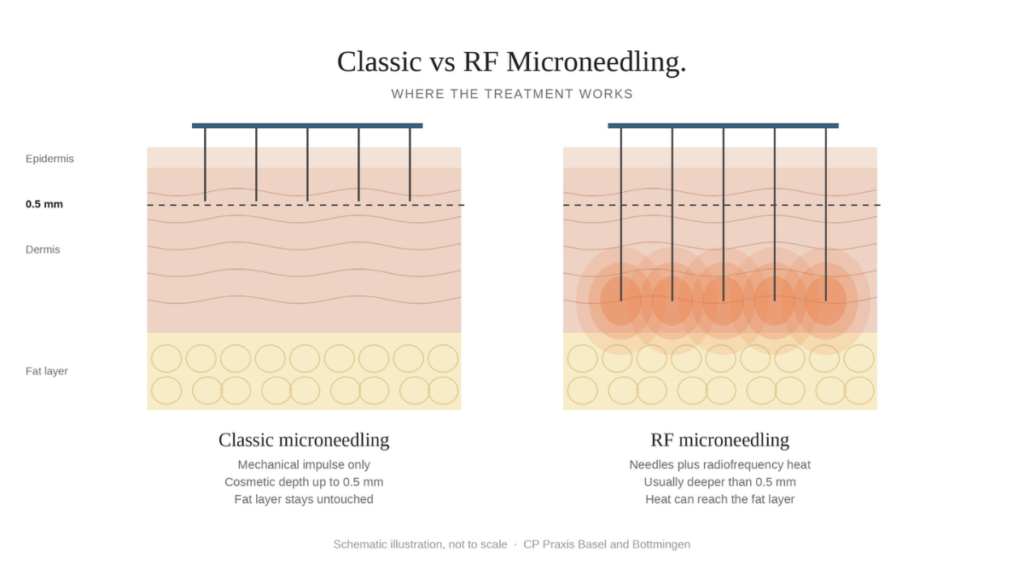
| Classic microneedling (CP Praxis) | RF microneedling | |
| How it works | Mechanical micro injuries stimulate the skin’s own repair | Needles plus heat from radiofrequency energy |
| Depth of effect | Skin layers where collagen and elastin are formed | Deeper, heat can reach the fat layer |
| Effect on facial volume | No heating of the fat layer | Possible loss of subcutaneous fat in some people |
| Downtime | Redness for up to 24 hours, light peeling | Often longer, depending on intensity |
| Typical price in Basel | CHF 150 to 240 | Usually CHF 250 to 400 |
| Best for | Acne scars, pores, texture, fine lines, prevention | Stronger laxity where volume loss is less of a concern |
| Who may perform it in Basel | Trained cosmeticians, within the cosmetic depth of up to 0.5 mm | Usually works deeper than 0.5 mm, which in Basel is a medical treatment reserved for doctors |
That is why we say: classic microneedling, individually combined. Your Skin Therapist adapts the treatment and the active care products to your skin at every session.
Microneedling has become popular, and with it a large market for low cost pens, rollers and needle cartridges sold online. They may look similar, but the difference for your skin is significant. The result of microneedling depends not only on the needles, but on how precisely and how hygienically they work.
At CP Praxis we work with dermaneed, a professional microneedling device developed by the Swiss company swissestetic AG in Baar. It is a significant investment compared to a standard pen, and there are good reasons for it.
Low cost devices often have unstable needle speed, imprecise depth and needles of uncertain origin. Uncontrolled microneedling, especially at home or with devices that are not made for professional use, can lead to infections, skin reactions and marks on the skin. Microneedling is a professional treatment, not a gadget.
Our tip: ask your practice which device is used, where the needles come from and who performs the treatment. At CP Praxis we are happy to show you.
This is an important question, because the rules are stricter than many people think.
Our advice: before any needle or device treatment, ask who performs it, which qualification that person has and how deep the needles go. A serious practice will answer these questions openly. You can check certificates of competence in the public register of the Federal Office of Public Health.
These three treatments are often confused. They have different goals:
Not sure which one fits you? A LumiScan Pro skin analysis shows what your skin needs before we choose a treatment.
Microneedling is a good choice if you want to improve:
Microneedling is generally not carried out, or only after consultation, in the following situations: active inflamed acne or skin infections, active cold sores, pregnancy, treatment with isotretinoin in recent months, a tendency to keloid scars, fresh sunburn, or certain medications such as blood thinners. Your Skin Therapist checks this with you before the first session.
Microneedling, like mesotherapy and most effective skin treatments, is not a one time treatment. The effect comes from repetition.
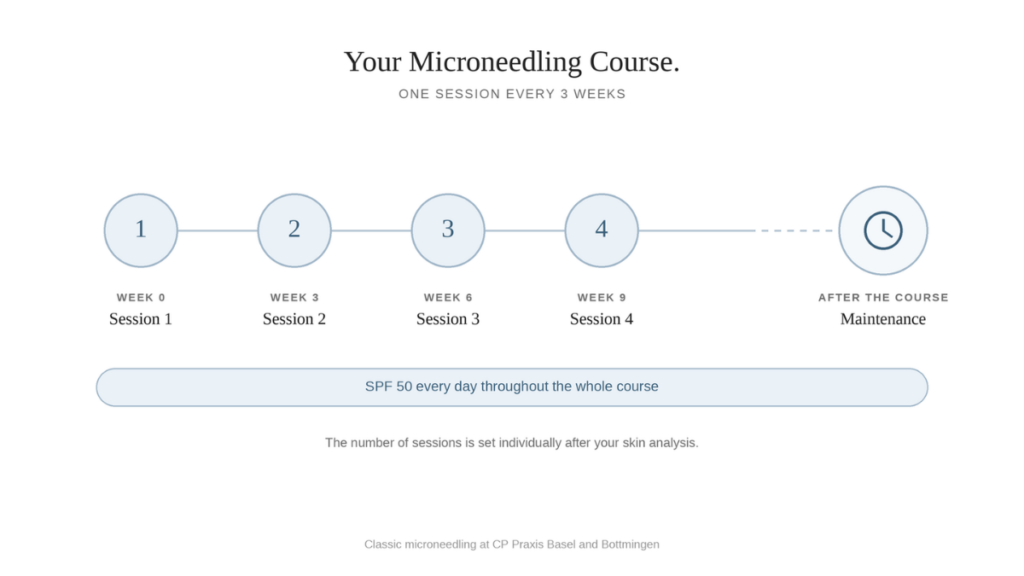
At CP Praxis we recommend a session every 3 weeks during a course. Why 3 weeks? Because the skin has started its own regeneration by then, and before that process slows down, we give it the next impulse. This keeps the repair process active.
How many sessions you need depends on your goal and your skin. Clinical studies usually work with 3 to 6 sessions. For acne scars, a longer course is often useful. After the course, maintenance sessions help to keep the result. Your Skin Therapist will set up a personal plan with you.
Most clients describe the feeling as a light scratching or warmth. For sensitive skin, a numbing cream can be applied before treatment, which makes the session comfortable.
Many clients see fresher, smoother looking skin after the first sessions. Because new collagen needs time to form and mature, the structural improvement of scars, pores and firmness becomes visible over several weeks and continues to develop for months after the course.
At CP Praxis we used to speak about anti ageing. Today we speak about skin longevity: keeping the skin healthy and strong for as long as possible, instead of changing a face. Microneedling fits this philosophy perfectly. It uses the skin’s own repair mechanisms, it strengthens the skin structure, and it does not change your facial volume.
That is why Magdalena Brügger calls microneedling one of the most valuable treatments for anyone who wants to plan ahead for healthy skin.
These photos show clients of CP Praxis before and after a course of classic microneedling, combined with individual home care and daily sun protection. They were taken with the clients’ consent.
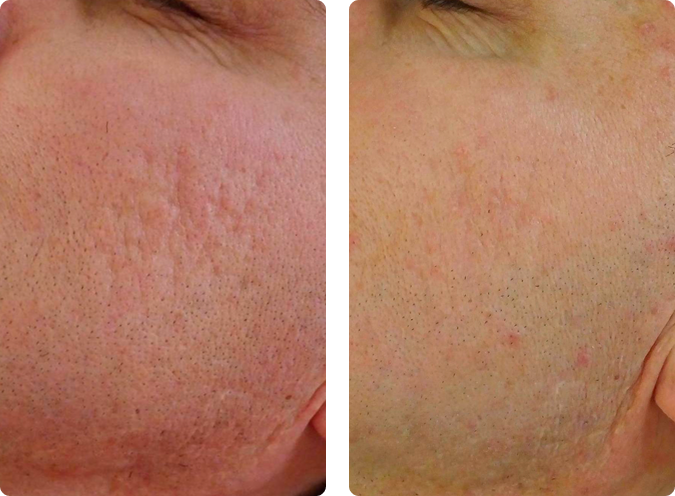
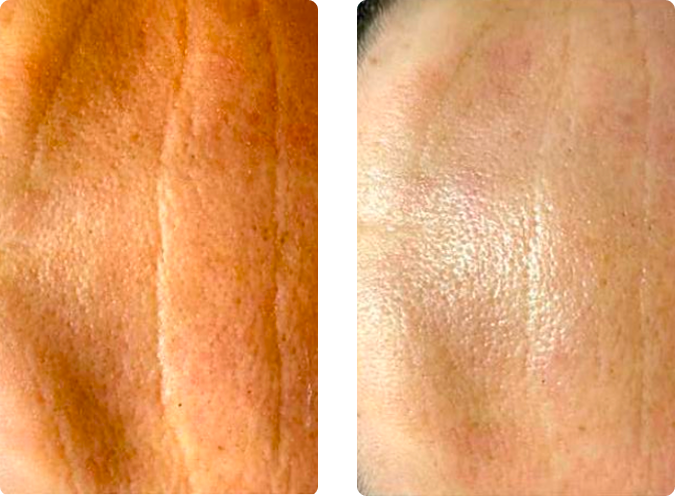
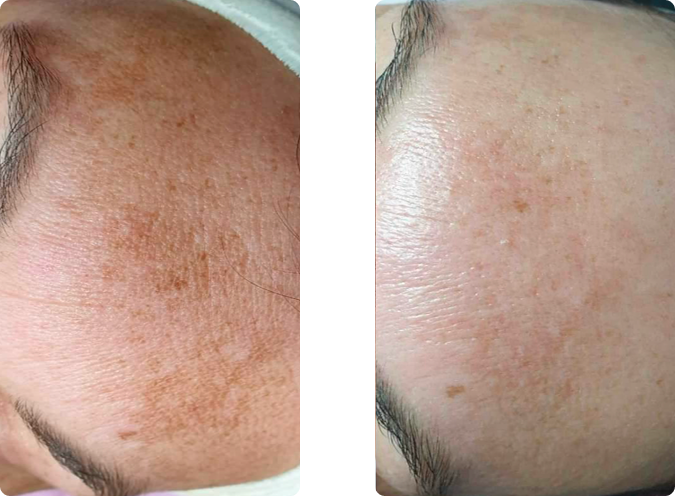
Results vary from person to person. The outcome depends on your skin, the number of sessions, home care and sun protection.
| Treatment | Duration | Price |
| Microneedling Eyes | 40 min | CHF 150 |
| Microneedling Face | 75 min | CHF 210 |
| Microneedling Face, Neck & Décolleté | 90 min | CHF 240 |
Every session includes a skin assessment and individually selected care. A short skincare consultation (15 minutes) is free. See all prices in our price list.
Microneedling is a skin treatment with very fine needles that create controlled micro injuries. The skin responds by producing new collagen and elastin, which improves structure, firmness and texture over time.
Yes, it is one of the better researched aesthetic treatments. Systematic reviews show that it is effective and safe for acne scars, and studies show a clear increase in collagen after a course of treatment. Results vary from person to person.
Microneedling works as a course. We recommend a session every 3 weeks. Studies usually use 3 to 6 sessions; your Skin Therapist sets the right number for your skin and goal.
Most people feel light scratching or warmth. For sensitive skin, a numbing cream can be applied beforehand.
Your skin may be red for up to 24 hours and may peel lightly a few days later. Most people return to their daily routine the next day. Avoid make up on the day of treatment.
Classic microneedling stimulates the skin mechanically. RF microneedling adds heat from radiofrequency energy, which can also affect the fat layer under the skin and, in some people, lead to a loss of facial volume. At CP Praxis we therefore use classic microneedling.
Home rollers and low cost pens often work with imprecise depth, unstable speed and needles of uncertain hygiene, which can damage the skin or cause infections. Professional microneedling uses a professional device, sterile single use needles and trained specialists.
Microneedling creates mechanical micro injuries to stimulate collagen. Mesotherapy brings active ingredients directly into the skin. They are often confused, but they are fundamentally different treatments.
Yes. Consistent sun protection with SPF 50 is essential during the whole course, to protect the regenerating skin and avoid pigmentation.
Acne scars are the best studied reason for microneedling. Over a course of sessions, the skin rebuilds collagen in the scar tissue and the texture can become smoother.
In Basel-Stadt, microneedling deeper than 0.5 mm counts as a medical treatment and is reserved for doctors with a professional practice licence. RF microneedling usually works deeper than this. Always ask who performs your treatment and which qualification they have.
At CP Praxis, microneedling costs CHF 150 for the eyes, CHF 210 for the face and CHF 240 for face, neck and décolleté. In Basel, classic microneedling usually costs between CHF 150 and CHF 240, while RF microneedling is often CHF 250 to CHF 400.
Last updated: October 2026
Magdalena Brügger founded CP Praxis in Bottmingen in 2008, after her Swiss training as a cosmetician HF with a specialisation in podology. Today CP Praxis has locations in Basel and Bottmingen and a team of more than 12 EFZ certified specialists. Her focus is skin health and skin longevity, with original devices and certified care brands.
Book your microneedling treatment in Basel or Bottmingen, or learn more on our Microneedling in Basel and Bottmingen page. New to CP Praxis? Read what to expect at your first appointment.
Basel: Freie Strasse 103, +41 61 271 16 27
Bottmingen: Schlossgasse 24, +41 61 421 92 09