
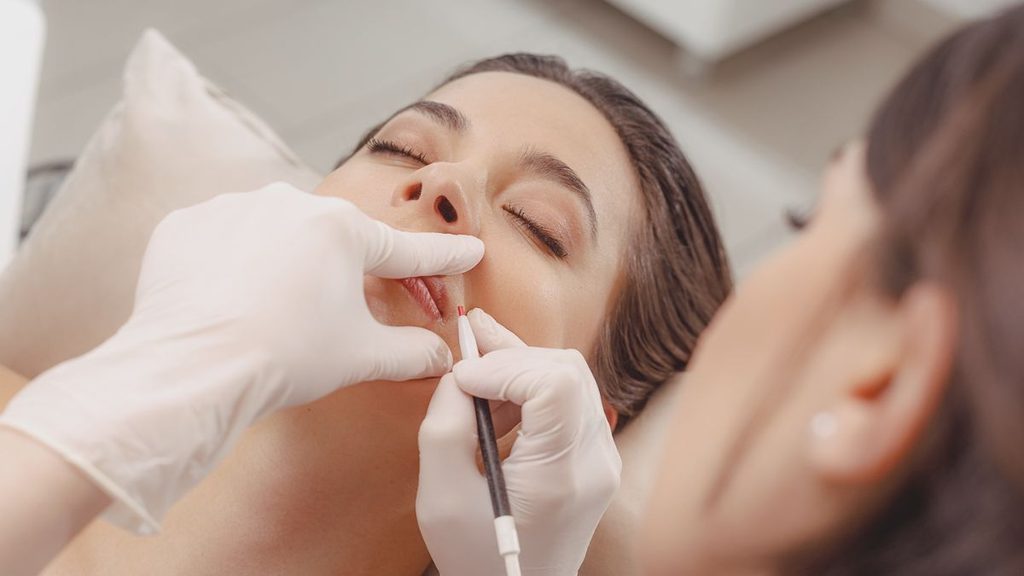
By Magdalena Brügger, founder of CP Praxis. Estimated reading time: 14 minutes
Quick answer: Electrolysis, also called needle epilation or electroepilation, treats every hair individually. A very fine single use probe is guided into the hair follicle, and a precisely controlled current cuts the hair root off from its blood supply, so that it can no longer regenerate. Because it does not depend on pigment, electrolysis also works on light, grey and white hair, where laser has no effect. At CP Praxis, we offer electrolysis with the Apilus xCell system in Basel and Bottmingen, and every treatment starts with a free 15 minute consultation.
Important: this article is an informational overview based on published information and our own experience since 2008. It is not medical advice and does not replace an individual assessment by a qualified professional. Individual results may vary.
Many of our clients come to us after years of plucking, waxing or trying laser without success. Often the reason is simple: their hairs are light, grey or very fine, and laser cannot see them. Or there are only a few strong hairs on the chin that keep coming back, no matter how often they are plucked. Electrolysis is the method that closes exactly this gap.
“Electrolysis is one of the most effective methods of hair removal we have. Today we recommend it above all for smaller areas, for hair that has already turned grey or lost its pigment, and for skin with a lot of pigmentation or many freckles.” Magdalena Brügger, founder of CP Praxis
In this guide, you will learn how electrolysis was developed, what happens in the skin during a treatment, who it suits and who should not have it, how many sessions you can realistically expect, how a session works step by step, how to prepare and care for your skin afterwards, and how electrolysis compares with laser, IPL and waxing.
In this article
- Electrolysis at a glance
- Watch: Magdalena Brügger explains electrolysis
- What is electrolysis and how does it work?
- Electrolysis or laser?
- Who is electrolysis suitable for?
- Why plucking makes it worse
- How many sessions do you need?
- Your session step by step
- Does it hurt?
- Preparation and aftercare
- Possible side effects
- Contraindications: when electrolysis is not suitable
- Myths and facts
- Real results at CP Praxis
- Prices and free consultation
- Frequently asked questions
Electrolysis at a glance
- What it is: hair removal with a fine probe, one hair at a time.
- How it works: galvanic current, thermolysis or a combination of both (blend method) treats the hair root and cuts it off from its blood supply.
- What it is best for: light, grey and white hair, strong single hairs on the chin and upper lip, eyebrow shaping, skin with a lot of pigmentation or many freckles.
- How it feels: a short warm or stinging sensation per hair. We work without numbing cream, and our clients have not needed it.
- Downtime: none. Slight redness usually settles within a few hours.
- How many sessions: quite a few, because hairs grow in cycles. For the chin or upper lip, often 8 to 15 sessions or more.
- Device: Apilus xCell, with sterile single use probes.
- Where: CP Praxis Basel, Freie Strasse 103, and CP Praxis Bottmingen, Schlossgasse 24.
- Not sure if it is right for you? Book a free 15 minute consultation. We tell you honestly whether you need laser, electrolysis, both, or nothing at all.
Watch: Magdalena Brügger explains electrolysis
The video is in German. You can find the key points and the full transcript in English on our electrolysis video page.
What is electrolysis?
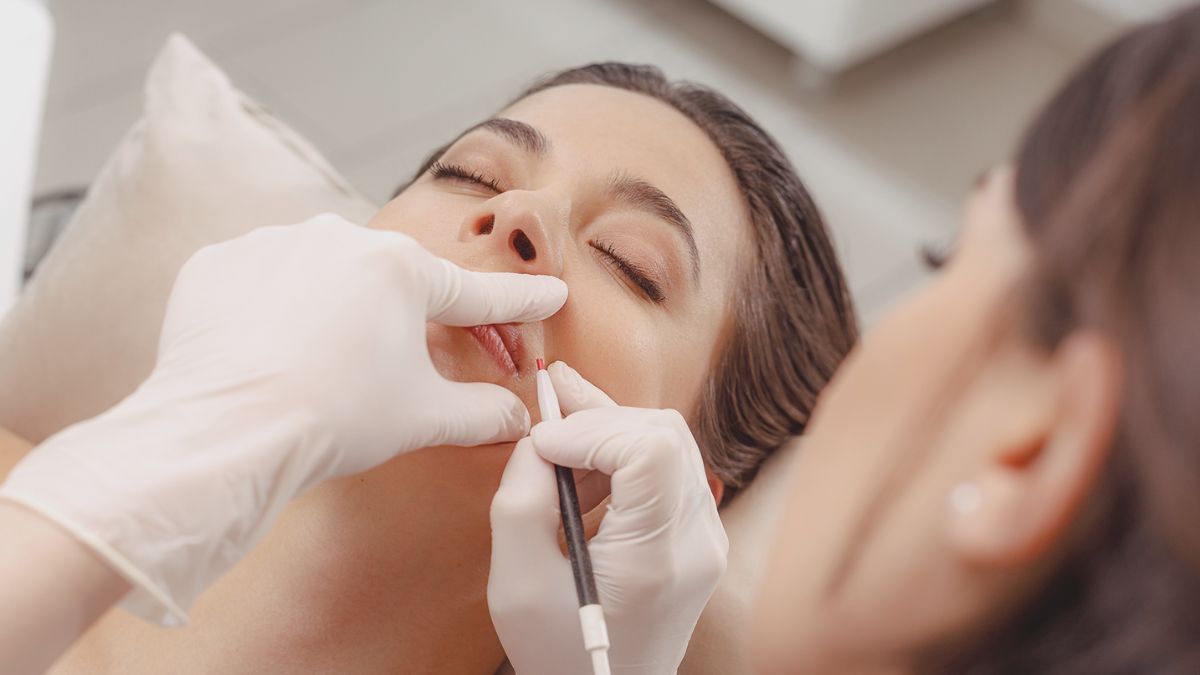
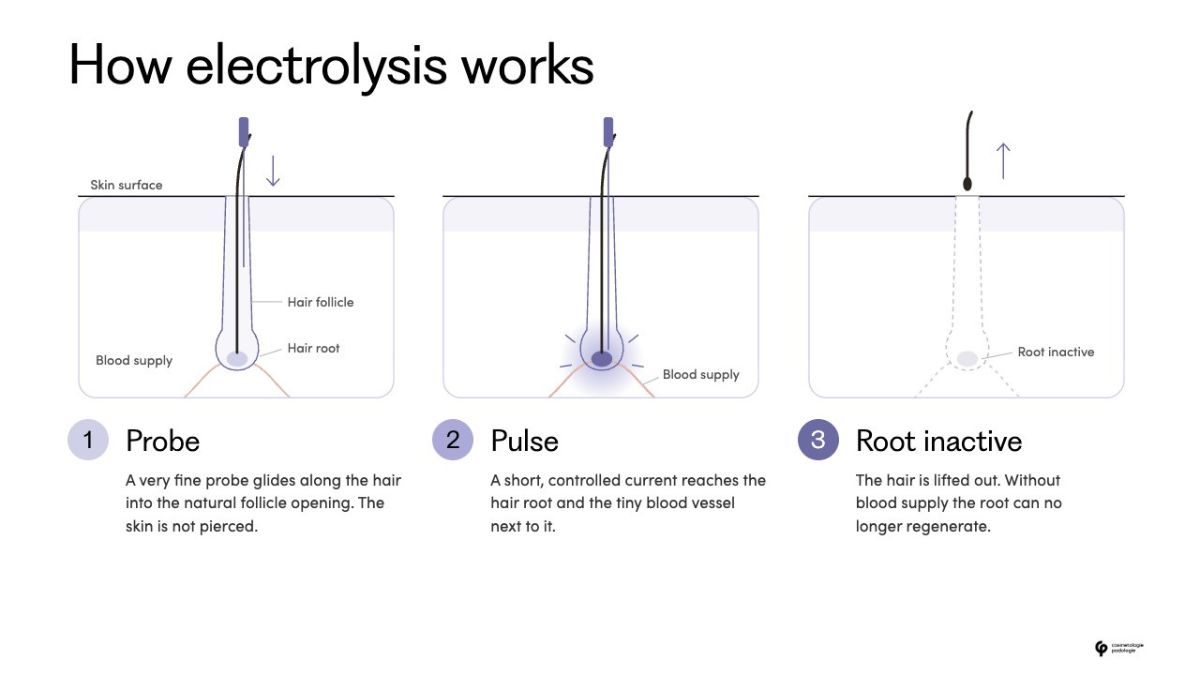
Electrolysis is the removal of individual hairs with a probe. Unlike laser or IPL, which treat a whole area at once, electrolysis works follicle by follicle. A very fine, sterile single use probe is gently slid along the hair into the natural opening of the follicle. It does not pierce the skin. A small, precisely controlled current then treats the hair root, and the loosened hair is lifted out with tweezers, without any pulling.
What matters is not only that the hair root is treated, but that it is cut off from the tiny capillaries that supply it with blood. As Magdalena explains in the video, a minute area of scar tissue forms deep inside the follicle, and the hair root can no longer regenerate. It is not the skin that is affected, only the hair root. This is what makes electrolysis so effective.
A short history: from eyelashes to the blend method
Electrolysis is one of the oldest hair removal methods in the world, and one of the best studied. In 1875, the American ophthalmologist Charles Michel used galvanic current for the first time to remove ingrown eyelashes, which were painful for his patients and damaged their eyes. Later, in the early 20th century, thermolysis followed, a method that works with high frequency heat and is much faster. In 1938, the two techniques were combined into the blend method, which is still the basis of modern electrolysis today.
Modern devices such as the Apilus xCell, which we use at CP Praxis, deliver energy in very short, computer controlled pulses. This makes the treatment far more comfortable and precise than the electrolysis many people remember from the past, and allows us to adapt the technique to every hair.
The three methods: galvanic, thermolysis and blend
| Method | How it works | Best for |
|---|---|---|
| Galvanic | Direct current creates a chemical reaction in the follicle that treats the hair root. | Thick, deep or curved hairs. Slower, but very thorough. |
| Thermolysis | High frequency current creates heat at the hair root. | Fine and medium hairs. Very fast. |
| Blend | Combines both: the heat of thermolysis with the chemical effect of galvanic current. | Most hair types, including strong hairs on the chin. |
Your specialist chooses the right method and energy level for your hair type and the treatment area. You do not need to decide this yourself.
Electrolysis or laser: which method is right for you?
This is the question we hear most often. Laser hair removal targets the pigment (melanin) in the hair. This makes it very efficient for dark hair on larger areas such as the legs, underarms or bikini line. But where there is little or no pigment, laser has nothing to work with. Electrolysis treats the follicle directly, so the hair colour does not matter.
| Electrolysis | Laser | IPL | Waxing | |
|---|---|---|---|---|
| Light, grey and white hair | Yes | No | No | Yes, but hair grows back |
| Dark hair | Yes | Yes, very efficient | Partly | Yes, but hair grows back |
| Skin with a lot of pigment or freckles | Yes | Limited | Limited | Yes |
| Best area size | Small areas and single hairs | Medium and large areas | Medium and large areas | All areas |
| Hair root treated | Yes, each hair individually | Yes, gradual reduction | Gradual reduction | No |
| Time per session | Longer, one hair at a time | Short | Short | Short |
Our rule of thumb: dark hair on a larger area: laser. Light, grey or single strong hairs on a small area: electrolysis. Mixed hair: a combination of both.
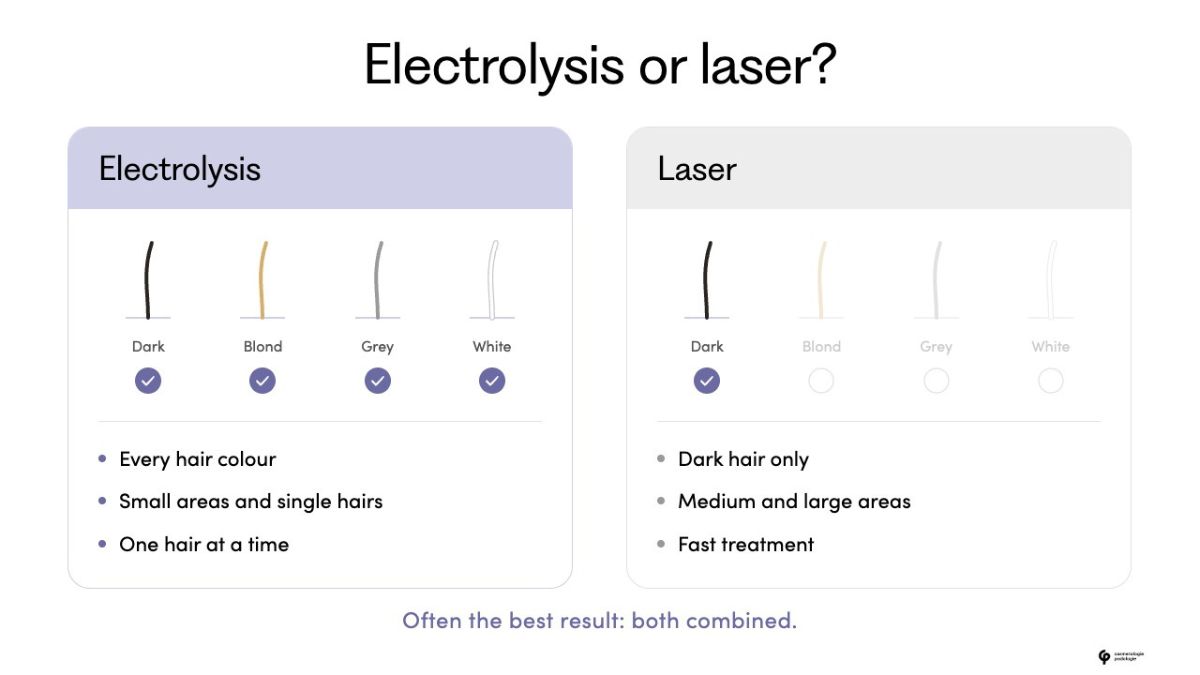
In practice, the two methods often work best together. We use laser for darker hair on larger areas, and electrolysis for light, grey and fine hairs, or for the last remaining hairs after a laser course. Because we offer both methods in the same practice, we have no reason to recommend one over the other. We recommend what works for your hair. Laser treatments at CP Praxis are carried out by specialists qualified under Swiss regulations (V-NISSG). You can read more in our article Laser vs IPL hair removal in Switzerland and on our laser hair removal page.
Who is electrolysis suitable for?
Grey, white and light hair
This is the most common reason our clients choose electrolysis. Once hair loses its pigment, laser and IPL no longer work, no matter how many sessions you do. Electrolysis can treat these hairs, because it works on the follicle, not on the colour.
Strong single hairs on the chin and upper lip
Strong single hairs on the chin, jawline or upper lip are very common, especially from the forties onwards and during hormonal changes such as menopause. They are often dark at first and turn grey later, which is exactly when laser stops working. With electrolysis, each of these hairs is treated at the root.
Eyebrows
Because electrolysis is so precise, it is ideal for shaping the eyebrows, for example for the hairs between the brows or single hairs outside the desired shape. Once treated, you no longer need to pluck them again and again.
Skin with a lot of pigmentation or many freckles
When the skin itself contains a lot of pigment, laser has to work very carefully, because the skin also absorbs energy. In these cases, as Magdalena explains in the video, we often recommend electrolysis instead.
Ingrown hairs
Hairs that keep growing into the skin and cause small inflamed bumps are a typical result of regular plucking or shaving. Treating these follicles with electrolysis removes the problem at its source.
Hormonally influenced hair growth
Increased hair growth on the face or body can have a hormonal cause, for example polycystic ovary syndrome (PCOS). Electrolysis can treat the hairs, but not the cause. If you suspect a hormonal background, we recommend a medical check with your doctor. In parallel, we create a long term treatment plan that is adapted to your hair growth.
Men
We regularly treat men, for example for the hairs between the eyebrows, on the ears, the neck or along the beard line, where precise lines matter.
Why plucking makes it worse
Almost every client with chin hairs tells us the same story: “I have been plucking them for years, and there are more and more of them.” Plucking removes the hair, but leaves the root alive. Over time, repeated plucking can irritate and distort the follicle, so the hair grows back crooked, stronger or ingrown. It also makes electrolysis harder, because a distorted follicle is more difficult to reach with the probe.
That is why we ask you to stop plucking as soon as you decide on electrolysis. Shaving or trimming is fine, because it leaves the hair and the follicle untouched.
How many sessions do you need?
Electrolysis requires patience, and we would rather tell you this honestly from the start. Hairs grow in cycles, and at any given time only part of them is visible on the surface. In one session, we can only treat the hairs that are currently visible. The others appear later and are treated in the following sessions. Some strong hair roots also need more than one treatment.
| Area | Typical number of sessions |
|---|---|
| A few single hairs | Fewer sessions, depending on the number of hairs |
| Eyebrows | Usually a small number of short sessions |
| Chin or upper lip | Often 8 to 15 sessions, sometimes more |
| Hormonally influenced hair growth | Often 15 sessions or more, over a longer period |
At the beginning, sessions usually take place every one to two weeks. As fewer hairs grow back, the intervals become longer, up to four to six weeks, and the sessions become shorter. A full course for the face often takes around 12 to 18 months. These are typical ranges, not a promise. After your consultation, you receive a personal plan.
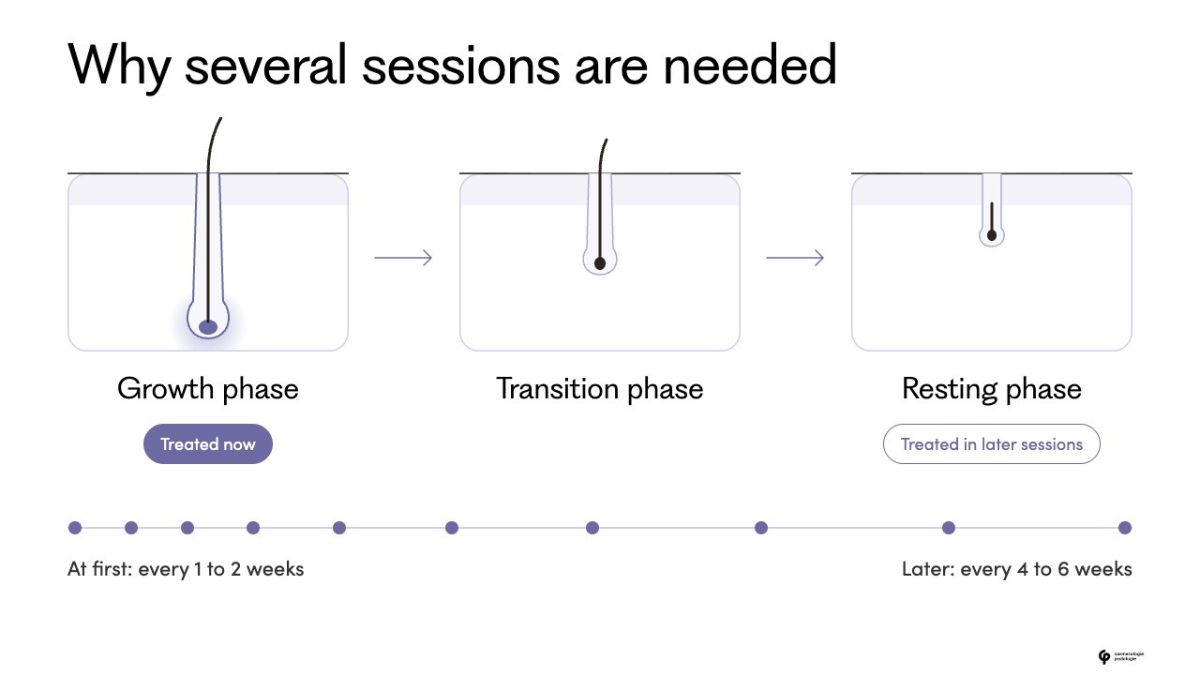
The good news: you see progress along the way. Every treated hair root is one less hair to deal with, and many clients notice a clear difference after the first few sessions.
Your session at CP Praxis step by step
- Consultation: before your first treatment, we look at your hair colour, hair type, skin and the area together, and check for contraindications. We decide on the right method and plan.
- Preparation: the area is cleansed and disinfected. A new, sterile single use probe is used for every client.
- Treatment: your specialist inserts the probe into each follicle, releases a short pulse and gently lifts out the loosened hair. Depending on the area, a session takes between 10 and 30 minutes or longer.
- Soothing: after the treatment, the skin is calmed with a soothing product.
- Your plan: we agree on the date of your next session and give you clear aftercare instructions.
Does electrolysis hurt?
Most clients describe a short warm or stinging sensation for each hair, which disappears immediately. Sensitivity depends on the area and on your personal tolerance: the upper lip is usually more sensitive than the chin, and many people feel more before and during their period. Thanks to the very short pulses of the Apilus xCell, the treatment is much more comfortable than older electrolysis methods. We work without numbing cream, and our clients have not needed it.
How to prepare for electrolysis
- Stop plucking, waxing and threading in the area for several weeks before your first session. The probe needs a visible hair as a guide into the follicle.
- Shaving or trimming is fine, ideally two to three days before your appointment, so that the hairs are visible and about 1 to 3 millimetres long.
- Come without make-up on the treatment area.
- Avoid strong sun and a sunburn on the area before your appointment.
- Drink enough water on the day of your treatment. Well hydrated skin is easier to treat.
- Tell us about medication, especially blood thinners, and about any skin conditions in the area.
Aftercare: what to do after your session
- Avoid make-up on the treated area for 24 hours, and do not touch or scratch it.
- Avoid the sauna, solarium, swimming pool and intense sport for 24 to 48 hours.
- Protect the area from the sun and use SPF daily.
- Use only mild, fragrance free care for a few days.
- If tiny crusts appear, do not pick them. They will fall off on their own.
- Do not pluck or wax the area between sessions. Shaving or trimming is fine.
Possible side effects
Electrolysis is a well established and safe method when it is carried out by a trained specialist with sterile single use probes. Typical reactions are temporary:
- Redness and slight swelling around the treated follicles, usually gone within a few hours to a day.
- Tiny dots or crusts, which heal within a few days if you do not pick them.
- Rarely, temporary pigment changes, especially on darker skin or after sun exposure. That is why sun protection is so important.
If anything feels unusual after your treatment, contact us. We are happy to take a look.
Contraindications: when electrolysis is not suitable
Your safety comes first. In the consultation, we check whether electrolysis is right for you. We do not carry out electrolysis, or only after medical clearance, in the following cases:
- Pregnancy.
- Pacemaker or other electronic implants, for example an implanted defibrillator.
- Epilepsy.
- Active skin infections, inflammation, open wounds or herpes in the treatment area.
- Hairs growing from moles or birthmarks, only after clearance by a dermatologist.
- A tendency to keloid scars.
- Blood thinning medication or blood clotting disorders: please consult your doctor before booking.
- Diabetes or other conditions that affect wound healing: please consult your doctor before booking.
- Recent sunburn on the treatment area: we wait until the skin has fully calmed.
If you are unsure, contact us before your first appointment, or simply mention it during your free consultation.
Myths and facts about electrolysis
| Myth | Fact |
|---|---|
| “Electrolysis leaves scars.” | When carried out professionally, with the right energy and good aftercare, the skin heals without visible marks. The tiny scar forms deep inside the follicle, not on the skin. |
| “One session is enough.” | No. Because hairs grow in cycles, several sessions are always needed. We tell you a realistic number from the start. |
| “Laser works on all hair.” | No. Laser needs pigment. Grey, white and very light hair cannot be treated with laser. |
| “I can keep plucking between sessions.” | No. Plucking removes the hair we need to treat and can distort the follicle. Shaving or trimming is fine. |
| “Electrolysis is extremely painful.” | With modern devices, most clients feel only a short warm or stinging sensation per hair. Our clients have not needed numbing cream. |
Real results at CP Praxis
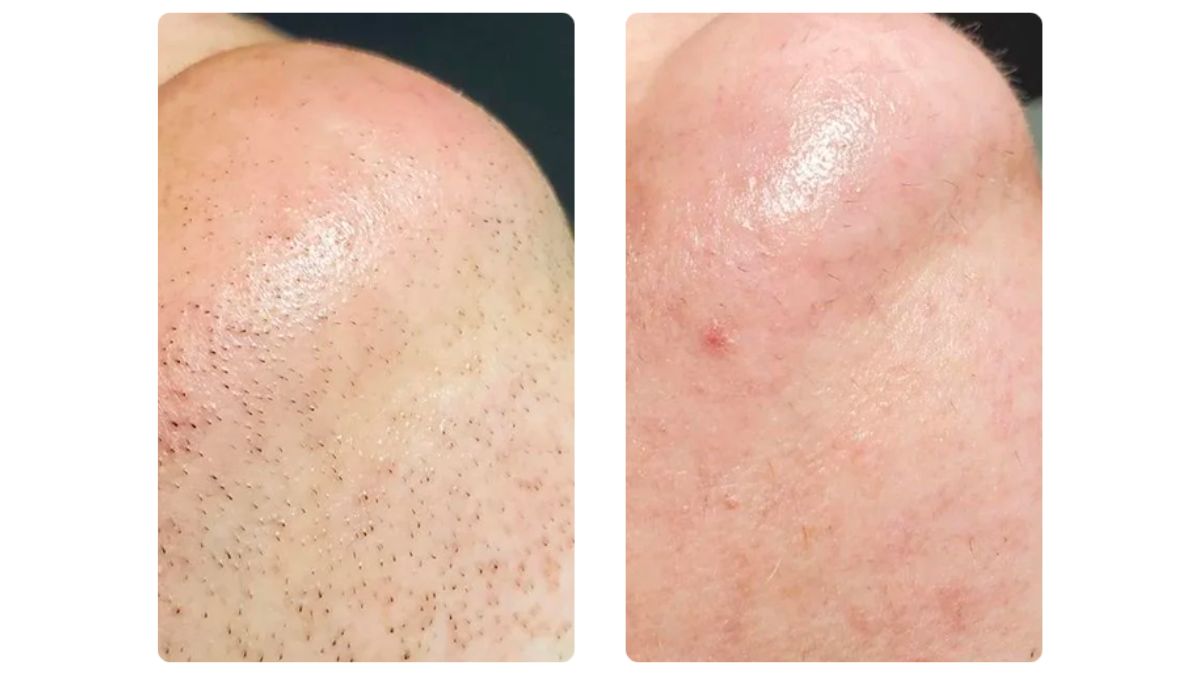
Starting point: persistent hair growth on the chin with a hormonal component, ingrown hairs and irritation from regular plucking.
Treatment plan: Apilus xCell electrolysis, each follicle treated individually, sessions every two to three weeks, plan adapted to the hair growth cycle.
Result after 8 sessions: clearly fewer hairs, no more ingrown hairs and calm skin without scarring or pigment changes. Individual result.
Why electrolysis at CP Praxis?
- Experience since 2008: CP Praxis was founded by Magdalena Brügger in Bottmingen and today has two practices in the Basel region.
- Apilus xCell: one of the leading professional electrolysis systems, with all three methods: galvanic, thermolysis and blend.
- Sterile single use probes for every client.
- Laser and electrolysis under one roof: we recommend the method that suits your hair, not the one we happen to offer.
- Two locations: Basel, Freie Strasse 103, and Bottmingen, Schlossgasse 24.
- Six languages: German, French, English, Italian, Polish and Russian.
What does electrolysis cost in Basel?
Because every client has a different number of hairs, electrolysis is charged by time. At CP Praxis:
- Minimum treatment: CHF 60 (10 min.)
- Treatment: CHF 90 (30 min.)
- Each additional minute: CHF 3
As the number of hairs decreases, sessions usually become shorter, and so does the cost per session. You can find all prices on our price list.
Free 15 minute consultation: laser, electrolysis or nothing at all?
Not every hair needs to be removed, and not every hair is right for electrolysis. That is why we offer a free 15 minute consultation. Together with you, we look at your hair colour, hair type, skin and the area you would like to treat, and decide what really makes sense: laser, electrolysis, a combination of both, or perhaps no treatment at all. You receive an honest recommendation, a realistic number of sessions and a clear plan. There is no obligation.
Book your free consultation: Basel
Book electrolysis directly: Basel | Bottmingen
Or call us: Basel +41 61 271 16 27, Bottmingen +41 61 421 92 09.
Frequently asked questions
What is electrolysis?
Electrolysis, also called needle epilation or electroepilation, is a hair removal method that treats each hair individually. A fine single use probe is guided into the follicle, and a small current treats the hair root so that it can no longer regenerate.
Does hair grow back after electrolysis?
A hair root that has been fully treated can no longer regenerate. Because hairs grow in cycles and some strong roots need more than one treatment, several sessions are needed. New hairs can still appear over the years, for example due to hormonal changes.
Does electrolysis work on grey and white hair?
Yes. Electrolysis does not depend on pigment, so it also works on light, grey and white hair, where laser and IPL have no effect.
What is the difference between electrolysis and laser?
Laser targets the pigment in the hair and treats larger areas quickly, which makes it ideal for dark hair. Electrolysis treats each follicle directly, regardless of hair colour, and is ideal for light, grey and single hairs and for small areas. The two methods can be combined.
How many electrolysis sessions do I need?
It depends on the area and the number of hairs. For the chin or upper lip, often 8 to 15 sessions or more are needed, at first every one to two weeks and later every four to six weeks. You receive a personal plan after your consultation.
Does electrolysis hurt?
Most clients feel a short warm or stinging sensation for each hair. The upper lip is usually more sensitive than the chin. We work without numbing cream, and our clients have not needed it.
Can I pluck my hairs between sessions?
No. Plucking removes the hairs we need to treat and can distort the follicle. Shaving or trimming is fine.
How should I prepare for electrolysis?
Stop plucking, waxing and threading for several weeks before your first session. Shaving or trimming is fine, ideally two to three days before, so the hairs are visible. Come without make-up on the treatment area.
Is there any downtime after electrolysis?
No. Slight redness and small dots around the treated follicles usually settle within a few hours. Avoid make-up for 24 hours and the sauna, solarium and intense sport for 24 to 48 hours.
Does electrolysis leave scars?
When carried out professionally, with the right energy and good aftercare, the skin heals without visible marks. It is important not to pick any tiny crusts and to protect the area from the sun.
Can electrolysis remove chin hair caused by hormones or PCOS?
Electrolysis can treat the hairs, but not the hormonal cause. We recommend a medical check with your doctor and create a long term treatment plan adapted to your hair growth.
Can electrolysis be combined with laser?
Yes. We often use laser for darker hair on larger areas and electrolysis for light, grey or single hairs, or for the last remaining hairs after a laser course.
Who should not have electrolysis?
Electrolysis is not carried out during pregnancy, in clients with a pacemaker or other electronic implants, with epilepsy, or with an active skin infection in the area. Hairs from moles are only treated after clearance by a dermatologist. If you take blood thinners or have diabetes, please consult your doctor first.
How much does electrolysis cost in Basel?
At CP Praxis, a minimum treatment costs CHF 60 (10 min.), a 30 minute treatment CHF 90, and each additional minute CHF 3. The 15 minute consultation beforehand is free.
Where can I have electrolysis in Basel and Bottmingen?
CP Praxis offers electrolysis with the Apilus xCell system at both practices: Freie Strasse 103 in Basel and Schlossgasse 24 in Bottmingen.

Author: Magdalena Brügger, founder of CP Praxis, Basel and Bottmingen. CP Praxis has been offering professional hair removal since 2008.